Glyphs
When trying to find information on an actual understanding of the Glyphs connected to the Hebrew letters, there are all types of speculation and assertions. The fact of the matter is that the amount of archaeological discoveries or “evidence” of the ancient Mesopotamian Glyphs, a.k.a. “Proto-languages” are rare and few.
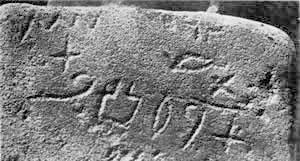
Image: Proto-Sinaitic inscription #346
Below are representations of images of Ancient Glyphs, specifically the 22 letter Alphabet which eventually became the Hebrew Alphabet.
Note: And through the Phoenicians evolved or influenced the development of the later Greek — and making its way to influencing Latin, romance languages (Italian, French and Spanish) and eventually influencing English.

The Head of Ox
“Traditional” Meanings:
Strength, Power, Leader
In ancient times, and still used by many people in today’s time, the ox was simply the power animal, or the forerunner of the tractor. Due to the strength of these hardy beasts, nomadic and farming cultures used them to pull carts by tying ropes around their horns. Later, with the invention of the yoke, which bound two oxen together. Additionally, the farming community used them to pull a plowshare, the upgraded process of tilling the soil compared to doing it by hand. This cooperation brings forth the plants needed for farmers’ survival, while oxen are cared for in return.
Its positioning as the first letter in the Alphabet represents the leadership position. The conceptual imagery of the relationship between putting the oxen up in front, as the source of power (pulling forward), and the farmer stabilizing (side to side motion) the plowshare (tilting in and pulling back) as they till the soil “together”.
.

Fig. 1-1 Tiller of Soil, Plowshare, and Ox
The next component represents perception. In this case, it’s the relationship a Farmer [Tiller of the Soil] has with the Ox. Symbolizing Mankind’s expression of… and relationship with “God.”
Note: The visual imagery as the Head of the Alphabet can then infer the collection of letters after it symbolizes the rest of the body of the Ox — [which may have some connection to the “Golden calf” story (with Moses and Aaron) – as a failure (or sin) of it | as well as, the generalized “Bull worship” of many ancient cultures].
The symbolic nature of the “Head” also seems to suggest the concept of location, as the “place where the spirit resides.” Symbolically, the concept of Spirit, Mind, and Thought are interchangeable. When applying the concept of thought to God, it represents the idea of “First Cause” or the “Primordial Origins.”
Thus, the “Head of …” can also be understood conceptually as the “Spirit of…” or “Mind of….” At its core, the “Head of Ox” glyph represents the Mind of God, and as the concept of the “All knowing” or absolute knowledge.

The Hebrew letter is written as א, pronounced as Aleph or Alef, אלפ (ALP), which is also the word for Oxen.

In English, it‘s the letter “A”. Additionally, it can be translated as the letter “E” (based on Hebrew pronunciation within specific words).
Note: The use of the A versus E appears to function as a symbolic aspect of relating the (A) to a grounded or earthly connection (the ox) versus the (E) as an elevated or sky/heavenly connection (the winged Ox, or other winged creatures — like Eagles (birds), Angels, etc.).
Examples of this pronunciation function:
אלהימ (ALHYM) “Elohim” [the plural version] or אל (AL) “El” [the singular version] as, God (concept of Sky God/Father)
אדמ (ADM) “Adam” translated as: “Man or Mankind”
Symbolically as (concept of God’s Creation in His Image [on Earth] – also as the concept of God’s Offspring/Son [as Earthly and the Grounded Father]. Later, Abram, as Exalted Father [the idea of the Mountain Father = as up high, but not winged], versus the “God Most High.”
Note: This concept of two levels, as higher and lower, also relates to the idea of the “Greater and Lesser” or even as the Heavenly and Earthly.


